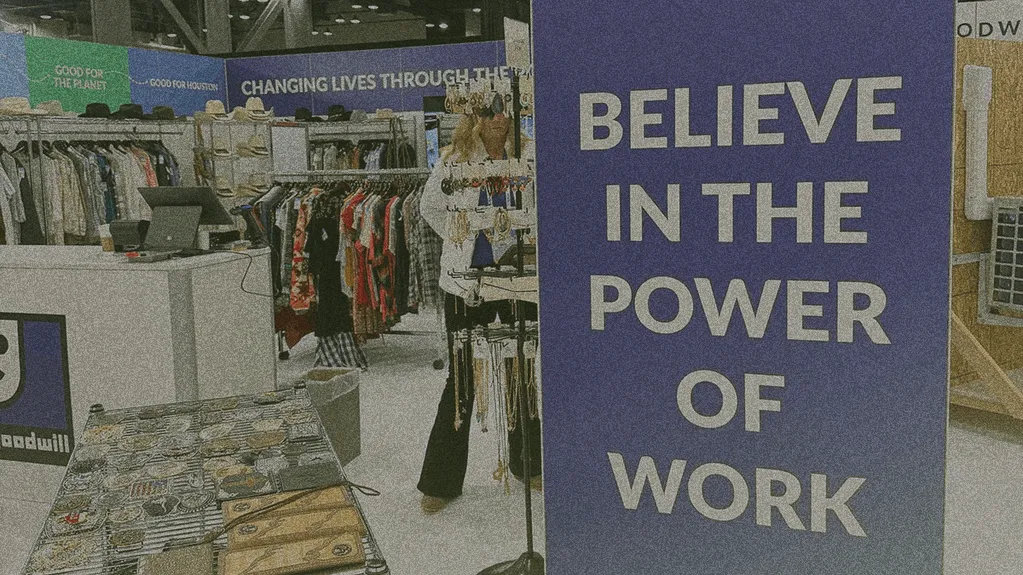
What Goodwill Connect taught us about the importance of local knowledge, strong partnerships, and a thoughtful approach to waste and recycling.
At Goodwill Connect 2026 in Houston, we heard how Goodwill organizations and their partners are keeping materials in use, creating jobs, and building sustainability into their daily operations. That work is delivering both financial and environmental benefits.
Their work reinforces something we believe at Sourgum, and as people who care about changing a broken industry: There is no one-size-fits-all approach to waste, recycling, or sustainability.
Meaningful progress starts with understanding the needs of a specific community or business, then equipping the people closest to the problem to address them.
Sustainability and Profitability Can Go Hand in Hand
During his presentation, “Reuse, Repair, and Community Impact,” Mortimer Capriles, Director of Sustainability and Innovation at Goodwill Industries of Alberta, shared how the organization repairs and repurposes donated goods, finds new uses for textiles, and works with community partners to keep more materials in circulation.
Those efforts are making a measurable difference. In 2025, Goodwill Industries of Alberta reported an 87% landfill diversion rate, keeping 23.8 million kilograms of donated materials out of landfills. Its repair and repurposing programs also create employment opportunities for people with disabilities.
Beyond the environmental and social benefits, these initiatives are delivering financial value. Every item repaired represents an opportunity to avoid disposal costs and generate revenue that can be reinvested into the organization's mission. Capriles said:
Sustainability has a huge positive impact on the profitability and financial well-being of any company in North America,.
The same link shows up elsewhere in the Goodwill network. In Ohio, the Goodwill organization serving Summit, Portage, Medina, Ashland, and Richland counties estimates that just 11% of the 18,224 tons donated in 2025 went to trash, and 91 cents of every dollar spent in its stores funds its mission.
This model is proof that sustainability and profitability can go hand in hand, reducing costs while creating more opportunities to invest in the communities the organization serves.
Sustainable Solutions Start with Understanding Local Needs
Part of what makes Goodwill’s model effective is its structure. Goodwill is a network of locally led organizations, each operating in a community with its own identity, challenges, resources, and opportunities. A program that works well in one region may need to look different in another, depending on which materials come through the door and which partners are nearby to help.
Waste and recycling operations are much the same.
A retail store, donation center, warehouse, and processing facility each generate different waste streams and need different services. Even two similar locations can differ in donation volume, available recycling infrastructure, local regulations, and opportunities for material recovery.
What works in Houston may not work in Denver, and what makes sense for a high-volume donation center may be unnecessary for a smaller neighborhood store.
Effective waste and recycling management starts with understanding what’s actually happening at each location. For retailers, that means asking a few practical questions:
What materials are being generated?
Which of them can be recovered locally?
What containers, collection schedules, and service providers fit that reality?
Better Partnerships Open Up More Possibilities
Goodwill doesn’t do this work alone. Its partnership with Habitat for Humanity shows how two organizations with different capabilities can find more uses for materials than either could on its own.
Through the partnership, donated furniture finds new opportunities for repair and reuse, and damaged textiles—otherwise treated as waste—are transformed into useful products. Instead of asking how to get rid of an unwanted item, the partners ask who can give it a new life.
That shift matters well beyond donated goods. As Jimmie Costello, Territory Manager at Sourgum, puts it:
Waste reduction isn’t rocket science. Someone probably wants your material. It just takes a little time, be that from a team or third party, to find the right missing link.
No single organization has the expertise, infrastructure, or resources to handle every material in every market. A more circular economy depends on retailers, organizations, facilities, haulers, and other local partners knowing what each can take on, and understanding what can realistically happen to them next.
From Local Action to Industry-Wide Progress
Making progress in individual communities is important, but creating lasting change on a larger scale requires two things:
Retailers need visibility into what they generate and where it goes. Diversion opportunities are hard to find without that information. Materials need somewhere to go, which depends on local recyclers, reuse partners, and processors that may or may not exist in a given market.
Collection has to be reliable. A missed pickup can create overflow at a busy donation center, and an outdated schedule can quietly drive up costs. These look like routine operational problems, but they determine whether sustainability goals are achievable at all.
Policy can help make these practices the norm rather than the exception. As Jimmie Costello, Territory Manager at Sourgum, explains:
I’m extremely interested in seeing how innovative waste policies, like EPR, construction recycling minimums, and composting mandates, pull landfill diversion from a fringe effort to an operational norm.
Local, independent haulers know their routes, their customers, and the facilities in their area. Giving these haulers the tools and opportunities to grow helps businesses put sustainability policies into practice and makes broader progress toward a zero-waste future possible.
That commitment to empowering independent haulers runs deep for our co-founders, who come from generations of work in the waste industry. As Sourgum co-founder and CEO Joe DiNardi-Mack explains:
Waste and recycling is essential work that every community depends on, and you can’t fix it from one side of the industry. Businesses need service they can rely on and understand. Haulers need the tools and opportunities to grow. Real progress happens when both get what they need.
The financial logic Capriles described holds in waste and recycling, too. In our work with businesses, right-sizing containers and pickup schedules, eliminating unnecessary fees, and identifying recoverable materials have helped customers find opportunities to reduce waste management costs by as much as 50%, while working toward landfill diversion rates of 80% or more.
Building a More Sustainable Future Together
Our biggest takeaway is that the circular economy isn’t built by any one organization or initiative. At Goodwill, it takes shape through repair benches, textile programs, and partnerships with organizations like Habitat for Humanity that create pathways for items outside Goodwill’s own capabilities.
This work shows what becomes possible when an organization understands its community’s needs and builds around them: less waste, lower costs, and more resources for the people they serve.
The same principle applies to waste and recycling. Better outcomes depend on understanding the materials each location handles, finding local partners who are equipped to handle them responsibly, and making the costs and results transparent enough to guide better decisions.
Progress toward a zero-waste future will come from making better decisions wherever we operate, one household, one business, and one community at a time.
